Generate: Imagine Analog
-
Hardware Engineer
-
Boston, MA
-
Sept. - Dec. 2022


Background: Generate is a client based, product design club at Northeastern that takes on multiple hardware and software projects every semester. My first project for Generate was Imagine Analog: a multi-effect analog guitar pedal that used FPAA (Field Programmable Analog Arrays) to keep the sound "pure" and relatively inexpensive to mass produce.
Task: I was one of two mechanical engineers on the team responsible for the outer casing and the internal mechanics of the guitar pedal. This included both the design and production of multiple prototypes leading to the final design seen above.
Skills Learned/Used
-
Design for Assembly, Machining, and Additive Manufacturing
-
Laser Cutting
-
Soldering
Outer Casing

Material Choice: Most guitar pedals on the market are made out of sheet medal for its nice finish and relatively low cost. Unfortunately, we did not have the tools to use sheet metal and make a well polished case. For this reason, we settled on 1/4 " aluminum sheets for the outer case. Aluminum is low cost, and strong enough for any reasonable forces being applied. It would also act as a heat sink for any electrical components held within.
Redesign: Half way through the semester, we were notified that we wouldn't have access to a milling machine for the aluminum plates. This changed the constraints of our project and forced us to outsource the top plate in aluminum while changing the sides and base plate to laser cut acrylic. Acrylic was chosen as a cost saving measure while still maintaining a clean finish.
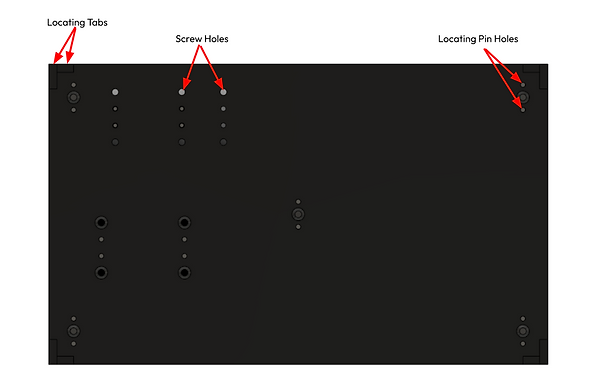
Design for Assembly and Machining: To make the assembly process go smoothly, locating features like pin holes and tabs were added to the bottom plate. Due to the change in manufacturing, the base and side plates had to be 2D extrusions and the top plate could only have machining done to one side.
Supports and Top Bar


Layout choice: To make it easier for the client to reach all six buttons with their foot, we decided to create a raised layer of buttons. To avoid long machining times, this was designed to be an additive part. Also, to decrease flex on the top sheet, five supports made of Nylon 12 are used. These supports used heat inserts to be fastened to the casing.
Pedal Sub-assembly

Gear Driven Potentiometer: A guitar pedal changes an effect in a linear way. The farther you press down, the more prominent the effect will be. In order to achieve this, we used a potentiometer connected to an Arduino. When someone stepped down on the pedal, it engaged a gear on a D-shaft. This shaft had an attachment on one end that connected to the potentiometer. All of these parts were 3D printed using Nylon 12 due to its availability to the team except for the D-shaft gear. Nylon 12's surface rubs away with wear so Formlabs Rigid 10k resin was used instead.
Final Prototype
