Honeybee Robotics, A Blue Origin Company: Space Exploration
-
Mechanical Engineering Intern
-
Pasadena, CA
-
July-Dec 2024


Background: During my time at Honeybee, I had the opportunity to design and build ground support equipment (GSE) for multiple projects and conducted early research into electrostatic travelling waves and its effect on moving lunar dust. This co-op taught me about the space industry as a whole while giving me direct experience with vacuum testing, mechanisms design, avionics, and a plethora of relevent skills in the industry.
Skills Learned/Used: TVAC Testing, Fastener Installation (helicoils, threaded inserts, ball bearing press), 8020 assembly, Autodesk Inventor with Vault, Design of Experiments, Electrical Harness Design and Building
TRIDENT Testing


My first month at Honeybee, I was on the team for our flagship lunar drill, TRIDENT (The Regolith and Ice Drill for Exploring New Terrain). I did work to obtain calibration curves for regolith compressive strength so we know the rock type the drill is going into during its flight mission in early 2025. This involved assembly of 8020 GSE to mount the large drill in a vacuum chamber, lunar regolith simulant prep and assisting with temperature and vacuum (TVAC) testing.
Excavation and Beneficiation

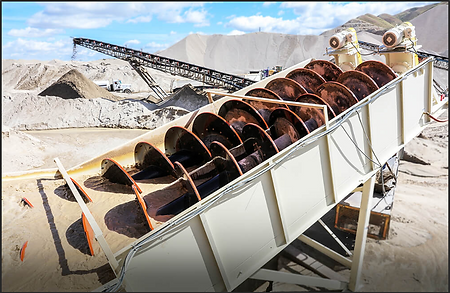
For the majority of my co-op, I was on a team focused on developing a system of excavation and beneficiation for future in situ resource development (ISRU) missions. My team's solution to the excavation problem was a 4 degree of freedom robotic arm with a scoop end effector. This arm could be mounted to a rover or a lunar lander and deliver lunar regolith to a beneficiation system. The beneficiation system will do initial material processing like size sorting and mineral sorting to increase efficiency of further processing for systems like solar panel manufacturing.
Excavation: Lunar Lander Mock up
The team I was on needed to develop an excavation system to dig into the "top soil" of the moon". Our solution to this was a 4 dof Robotic Arm that could be attached to a lunar lander or rover.

I was tasked with the sole responsibility of building a mock lunar lander to attach this robotic arm onto. This would give the arm mission context and provide realistic boundary conditions to test movement around. Blue's Mark 1 Lander was chosen as a guide for this build and below is my initial design in CAD using mostly 3"x3" 8020, next to a render of the actual lander. The task was to build a 1 to 1 scale model of an eight of this lander (bottom half, 90 degree slice).
Blue's Mark 1 Lander (26 feet tall)

Initial CAD for Structural Parts
Overlaid Lander Visuals

Robotic Arm Placement on Lander


After going through an initial design review with the team, I got approval to begin the building phase. Throughout building I was also designing the remainder of the structure's additional subassemblies. This includes paneling, tanks, and lander legs/struts. This build taught me a lot including but not limited to conduit bending, sheet metal riveting, how to work on ladders in a safe manner, and best methods for working in assembly CAD.

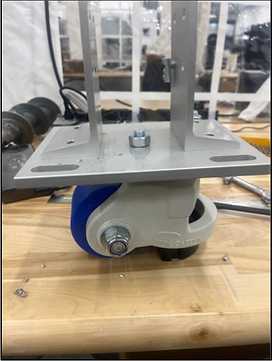


A problem that I quickly faced was making this structure portable. This requirement was not my decision but it meant that anchoring into the concrete was no longer an option. Instead, I used counter weights to put the center of gravity of the mock up within safety bounds of tipping over. The C.G was analyzed using Inventor with mock weights to simulate the robotic arm.

Summary: On the excavation side of the project, I was tasked with designing and building a 1:1 scale lunar lander mock up that was based off of Blue Origin's Mark 1 Lander. This mock up would have the robotic arm mounted to it to give the excavation solution context and realistic boundary conditions. This was designed in Autodesk Inventor and including many subassemblies like fuel tanks, paneling, and leg and struts. The fabrication of the mock up taught me many skills including conduit tube bending, sheet metal riveting, and how to overcome a fear of heights when working on tall ladders. The main worry of this mock up was maintaining an appropriate center of gravity so the 80 pound, 7.5 ft long arm would not tip the structure over. The solution to this was changed throughout the building process but was settled by adding a large amount of weight to the back bottom of the mock up.
Electrostatic Beneficiation
After working on the excavation side with the mock lander, I was tasked with developing a lower TRL system with the goal of using it for beneficiation. Beneficiation refers to initial material processing like size and or mineral sorting. The type of beneificiation I looked into is called Electrostatic Beneficiation.

Electrostatic testbed moving silica
This project involved a lot of white paper reading and understanding a relatively new science. These high voltage wires create a changing electrostatic field. This field then interacts with particles atop of the testbed based on the particles size, charge type, and dipole properties. Because of how new this research is, there were a multitude of variables that were hard to control and were attacked in different ways throughout the process.


The initial setup for this project involved a lot of benchtop electrical equipment like power supplies, function generators, and oscilloscopes. The initial testbed was a circular tube with electrodes/wires wrapped around. This is due to some legacy architecture I company had from a previous project. This initial setup was getting little to no results so I quickly changed the testbed to a flat surface to be able to see what was going on. This change led to instant results in silica transport and size sorting of minerals.
Initial Setup for Electrostatics


First Movement on Flat Plate

Once I got to this point, I was noticing some unexpected results with the setup. I was attempting to get frequency vs movement data of different minerals but during the silica trials the sand seemed to move less the more experiments I did. Adding to that, the silica would change its behavior if I breathed on it or touched it with my finger. This led to the need to look at humidity and precharge more closely. To do this, I made a large test matrix in excel and began testing. The results showed that humidity of the test samples greatly changed the flow rate of the materials.


After having a better control and understanding on external variables, the team wanted to put this into vacuum testing to see how it would do without air drag. We also ordered various mineral types found in lunar simulant and sieved them to certain sizes. The purpose of this is to see how the testbed reacts to different mineral types and sizes. To increase the amount of minerals we could put into the system, I took a part a toy excavator and wired it through the vacuum chamber. This allowed me to put in different minerals sizes through testing wihtout breaking chamber and worked surprisingly well.
Vacuum Testing Design


Sadly, my co-op ending during the middle of testing so the remainder of the work was left to a coworker. Overall this project was very intellectually challenging and fun to work on. The future of this technology has a lot of paths including clearing solar cells and cameras of dust on the moon and beneficiation of lunar regolith. Mineralogical separation needs to be looked into more, especially the ability to charge certain particles with UV light of differing energies. During this project, I got to learn a lot about harnessing and electrical equipment, some of which is shown below.
PCB Design for Dust Clearing

Summary: After my work on the lunar lander mock-up, I was tasked with exploring a type of beneficiation that the team had not looked into deeply. This is called electrostatic beneficiation and uses high voltage electrodes (up to 12000 volt difference) to move both charged and uncharged particles. I read up on current research, helped design and develop test bed, and conducted early research on the physics taking place, narrowing in relevant parameters and iterating designs. I then led a TVAC campaign to show the movement of lunar regolith simulant under moon like conditions. This progressed the electrostatic set up to TRL 4. I also helped with the design of some PCBs to test dust removal for other applications like solar cells, cameras, and astronaut suits.
Harnessing

Summary: Six months at Honeybee taught me a tremendous amount about the aerospace field as a whole while simultaneously giving me hands on exxperience with design, manufacturing, and testing of whole systems. It increased my passion for space exploration and gave me just a taste of what a career in the space industry would look like.